
Learning to Recognize Overgiving, Inherited Patterns, and the Love We Forgot to Give Ourselves
There are some realizations that arrive quietly.
And then there are the ones that stop you in your tracks.
The ones that make you look back over your life and suddenly see something that was there all along.
For me, one of those realizations has been overgiving.
Not simply giving too much of my time, energy, love, or attention.
But understanding why I was giving so much.
Because nobody really teaches us about overgiving.
We learn about kindness. We learn about generosity. We learn about being a good friend, a good partner, a good daughter, a good person.
We learn to show up for others.
But how often are we taught to recognize when showing up for everyone else means slowly disappearing from our own lives?
How often do we learn that giving can become a way of seeking love?
Or that we can become so accustomed to pouring into others that we no longer notice our own cup is empty?
I certainly didn’t.
And when I look back now, I can see how the pattern unfolded.
The Lessons We Learn Without Realizing We’re Learning Them
I wonder how many of us grew up watching the people we loved give more than they received.
Maybe it was a parent who constantly sacrificed for the family.
Maybe it was a mother who kept giving to a relationship, hoping for more love, attention, or appreciation.
Maybe it was a father who poured himself into friendships, always showing up, always helping, always being the one others could count on.
Maybe it was simply the way love was modeled in your home.
You gave.
You helped.
You made yourself available.
You put someone else’s needs first.
And somewhere along the way, a quiet belief began to form:
If I give just a little more, maybe they will like me more.
If I am there for them, maybe they will be there for me.
If I make myself valuable enough, maybe I won’t be forgotten.
We may never have consciously thought those words.
But sometimes our actions tell a story our minds haven’t yet recognized.
And when we grow up surrounded by these patterns, they can feel completely normal.
We don’t necessarily see them as overgiving.
We see them as love.
We see them as loyalty.
We see them as being strong.
We see them as being the person everyone can count on.
And sometimes, we don’t realize how much of ourselves we’re giving away until we finally stop and look back.
When I Lost My Dad, I Lost More Than My Dad
My father passed away in 2003.
I was 23 years old.
And I didn’t just lose my dad.
I lost my best friend.
That loss changed me in ways I couldn’t fully understand at the time.
When you lose someone who is such a significant part of your life, you don’t necessarily know what pieces of yourself will go missing, too.
You know you’re grieving the person.
But sometimes, you’re also grieving the safety, connection, friendship, and sense of belonging that existed within that relationship.
Looking back now, I can see that I was searching for something I had lost.
I wasn’t consciously thinking that if someone loved my dad, they would automatically love me.
I wasn’t deliberately trying to become him.
But I was young, and I had lost a friendship that meant everything to me.
And somewhere inside, I began to believe that perhaps I would never experience that kind of friendship again.
So I poured myself into my future husband.
I gave my time.
My energy.
My attention.
My love.
My loyalty.
I invested in the relationship, and I invested in the hope that I had found that deep sense of connection again.
And I didn’t see myself disappearing.
Because I still saw myself as a strong, independent woman.
And I was.
That part was true.
But I am beginning to understand that being strong and independent doesn’t mean we cannot become dependent on being loved, needed, or chosen.
We can be capable of handling our lives while still desperately needing someone else to fill an emotional space inside us.
We can be independent in every practical sense and still abandon our own needs in the pursuit of connection.
I didn’t recognize that distinction then.
I do now.
And that awareness changes the way I understand my past.
When Giving Becomes a Way of Holding On
Overgiving doesn’t always look like weakness.
Sometimes it looks like strength.
It looks like being the one who makes everything happen.
The one who remembers every detail.
The one who checks in.
The one who helps solve the problem.
The one who keeps the friendship alive.
The one who gives another chance.
The one who takes on just a little more responsibility.
The one who says, “It’s okay. I can handle it.”
And because we can handle it, we may never question whether we should have to.
I can see now how I created unhealthy boundaries in my own life.
Not because I didn’t know how to be strong.
But because I was so invested in being loved and maintaining connection that I didn’t recognize where my responsibility ended and someone else’s began.
I thought I was building relationships.
Sometimes, I was building relationships.
But sometimes, I was building relationships around how much I could give.
And those are not always the same thing.
A relationship built on mutual love and connection allows both people to show up as themselves.
A relationship built around overgiving can quietly teach us that our value is connected to what we provide.
And the more we give, the harder it can become to recognize whether someone loves us or simply loves what we do for them.
Divorce Doesn’t Just Divide the Assets
When my marriage ended, I began to see another layer of this pattern.
We often talk about divorce in terms of dividing the house, the finances, the belongings, and the responsibilities.
But divorce can divide friendships, too.
It can change families.
It can change communities.
It can change the way people see you and the way you see yourself.
And when you’re already carrying the grief of losing a relationship, the thought of losing even more can feel overwhelming.
I was so worried about being loved.
So worried about maintaining connection.
So worried about what I might lose.
That I found myself giving even more.
More time.
More energy.
More effort.
More of myself.
I thought that if I continued to show up, perhaps I wouldn’t lose the people, relationships, or connections that mattered to me.
But looking back, I can see something I couldn’t see then.
I was pouring into people and businesses that weren’t necessarily pouring into me.
I was investing in relationships that weren’t always reciprocal.
And I was trying to preserve connections without asking myself an important question:
Is this relationship nourishing me, too?
That question can be difficult when you’ve spent years believing that being a good person means continuing to give.
Because sometimes, we confuse being needed with being loved.
We confuse being useful with being valued.
And we confuse how much we can carry with how much we should carry.
When Your Hive Runs Dry
This is where my mind keeps returning to the image of a beehive.
A hive is a beautiful example of cooperation.
There are different roles, different responsibilities, and different ways of contributing to the greater good.
The queen has her role.
The worker bees have their roles.
The bees that gather nectar and pollen have their roles.
Together, they create something that can flourish.
But the hive doesn’t thrive because one bee does everything.
It thrives because there is a system of contribution, nourishment, and exchange.
There is movement.
There is purpose.
There is cooperation.
There is a kind of balance in the way the hive sustains itself.
And I began to wonder:
What happens when we spend our entire lives pollinating everyone else’s hives?
When we are constantly gathering what others need?
When we are helping their relationships grow?
When we are nurturing their dreams?
When we are making sure their businesses flourish?
When we are showing up for their lives?
And all the while, our own hive is running dry.
That was the realization that stopped me.
I had become so accustomed to nurturing everyone else’s hives that I hadn’t noticed how little was being brought back to mine.
And perhaps the most difficult part wasn’t realizing that I had given too much.
It was realizing that I had participated in the pattern.
I had said yes.
I had continued showing up.
I had made myself available.
I had given more.
And sometimes, I had done all of that without ever asking whether the relationship was capable of giving back.
Not because I was foolish.
Not because I was weak.
But because I had learned to measure love through giving.
And I was still learning that love is also something we are allowed to receive.
Overgiving is Not the Same as Loving Deeply
I want to be careful here.
Because I love deeply.
And I don’t want to lose that part of myself.
I don’t want to become someone who stops caring.
I don’t want to stop helping.
I don’t want to stop showing up for the people I love.
I don’t want to stop being generous.
Those things are beautiful parts of who we are.
The lesson isn’t that giving is bad.
The lesson is that giving without receiving can become a way of abandoning ourselves.
There is a difference between giving from a place of fullness and giving from a place of fear.
Giving from fullness might sound like:
“I have the time, the energy, and the desire to do this. I would love to help.”
Giving from fear might sound like:
“If I don’t do this, will they still want me?”
“If I say no, will they be disappointed?”
“If I stop being the one who holds everything together, will this relationship fall apart?”
“If I don’t keep giving, will I lose them?”
Sometimes, the outside action looks exactly the same.
We help a friend.
We support a partner.
We contribute to a business.
We take care of our family.
But the energy underneath the action is different.
One comes from choice.
The other may come from the fear of what might happen if we stop.
And that is where the healing begins.
Not by judging ourselves for what we gave.
But by becoming curious about what we were hoping to receive.
The Part of Me I Forgot to Nurture
When I look back over these 46 years, I can see how much of my life was spent trying to create connection.
Trying to be a good friend.
Trying to be a good partner.
Trying to be supportive.
Trying to make things work.
Trying to make sure the people around me were okay.
And I can honor that version of myself.
She was doing the best she knew how to do.
She was trying to love.
She was trying to belong.
She was trying to create the kind of friendship and connection she had lost.
She was trying to make sure the people she loved stayed.
But somewhere along the way, she forgot to ask:
What do I need?
What brings me joy?
What nourishes me?
Who am I when I’m not taking care of someone else?
What would it feel like to be loved without having to earn it?
Those questions are changing everything for me.
Because I am beginning to understand that I don’t have to give away pieces of myself to make sure I remain worthy of love.
I don’t have to keep proving that I am a good friend.
I don’t have to be endlessly available to deserve connection.
I don’t have to overextend myself to maintain relationships that are meant to be mutual.
And I don’t have to abandon the beautiful, giving parts of myself in order to create healthier boundaries.
I can still be generous.
I can still be loving.
I can still show up.
But I can also show up for myself.
Rebuilding the Hive
Maybe healing overgiving isn’t about suddenly becoming someone who gives less.
Maybe it’s about becoming someone who gives with awareness.
Someone who notices when their energy is depleted.
Someone who recognizes when a relationship has become one-sided.
Someone who can say no without believing they have done something wrong.
Someone who can accept help without feeling guilty.
Someone who can receive love without immediately trying to repay it.
Someone who understands that their needs matter, too.
For me, rebuilding the hive means learning to bring my energy home.
It means asking where my time is going.
Where my attention is going.
Where my resources are going.
And whether the places I am investing in are also nourishing me.
It means allowing relationships to reveal themselves through reciprocity rather than trying to sustain them through effort alone.
It means understanding that I cannot make every hive flourish.
And I don’t have to.
Every person has their own life to tend.
Their own work to do.
Their own relationships to nurture.
Their own responsibility for what they bring into the world.
I can love people without managing their lives.
I can support people without carrying their burdens.
I can celebrate someone else’s growth without neglecting my own.
And I can walk away from relationships that continually drain me without deciding that I am unlovable.
That last part is important.
Because sometimes, when we stop overgiving, we discover who was connected to us—and who was connected to what we provided.
That can hurt.
But it can also be clarifying.
And sometimes, clarity is the beginning of freedom.
You Are Part of the Hive, Too
If you’ve spent your life being the one who gives, perhaps this is your invitation to pause.
Not to stop loving.
Not to stop helping.
Not to stop being the beautiful person you are.
But to begin noticing yourself in the equation.
When you give your time, is there room for you to rest?
When you give your energy, is there anything replenishing you?
When you support someone else’s dreams, are you making space for your own?
When you show up for everyone else, who is showing up for you?
And perhaps the most important question:
Are you giving because you genuinely want to, or because some part of you believes you must in order to be loved?
There is no shame in discovering that you have lived from that place.
Many of us learned these patterns long before we had the words to describe them.
We learned them through family.
Through relationships.
Through loss.
Through the ways we watched people love each other.
And sometimes, we repeat them simply because they are familiar.
But familiar does not mean permanent.
We can learn a new way.
We can learn that love doesn’t have to be earned through exhaustion.
We can learn that boundaries do not make us selfish.
We can learn that receiving is not taking.
We can learn that being supported is not a weakness.
And we can learn that our own lives deserve the same care, attention, and nourishment we so freely offer others.
Because a healthy hive needs every part of itself.
And you are not just the worker bee.
You are not just the one who gathers.
You are not just the one who nurtures.
You are not just the one who makes sure everyone else has what they need.
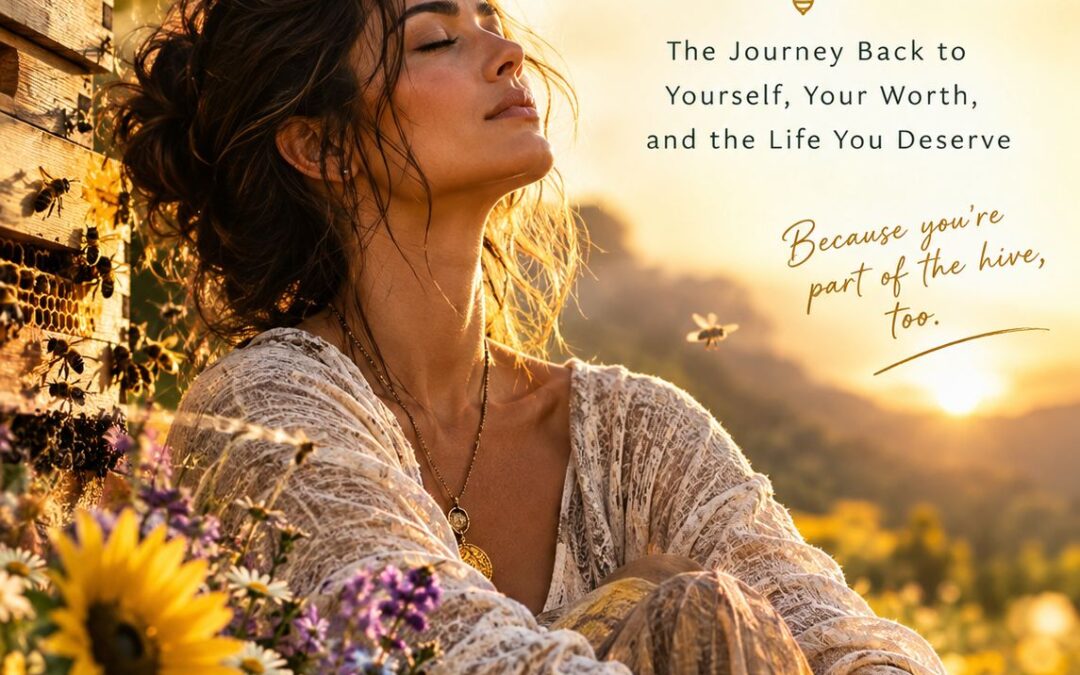
You are part of the hive, too.
Your needs matter.
Your dreams matter.
Your energy matters.
Your joy matters.
And the love you give yourself is not what remains after everyone else has received theirs.
It belongs in the center of your life.
So perhaps this is the season of bringing the nectar home.
Of tending to your own hive.
Of allowing yourself to be nourished.
Of discovering what happens when you stop pouring from an empty place and begin giving from a life that is being replenished, too.
Because you were never meant to spend your entire life pollinating everyone else’s hives.
You were meant to flourish in your own.