Coming home to yourself, recognizing what restores you, and no longer sacrificing yourself for what no longer does
For so long, I thought the answer was learning how to give less.
After everything I’ve been uncovering about overgiving, that would seem like the obvious conclusion.
Set better boundaries.
Say no more often.
Stop doing so much.
Stop taking responsibility for everyone.
Stop pouring into people who don’t pour back.
And yes, all of those things can be important.
But the deeper I go, the more I realize that this isn’t really a story about giving less.
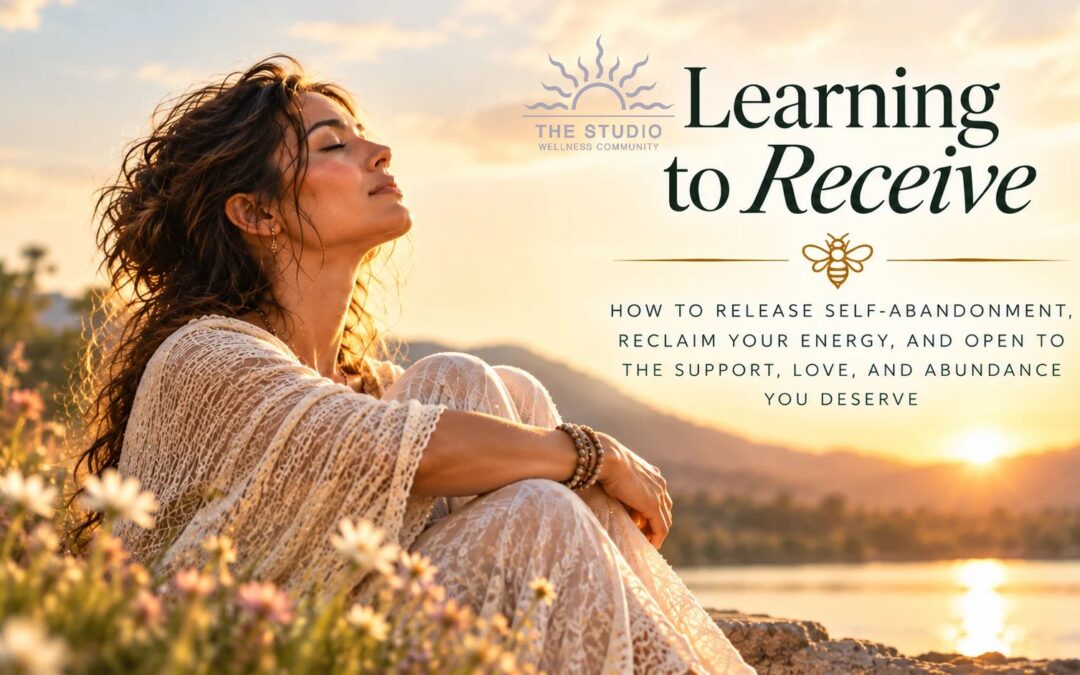
It’s a story about learning to receive.
Because when you’ve spent your life giving, receiving can feel surprisingly unfamiliar.
Giving is active.
We know how to do it.
We can measure it.
We can see what we’ve accomplished.
We can point to the things we’ve done and say, See? I contributed.
Receiving is different.
Receiving asks us to soften.
To pause.
To allow.
To trust.
To let something come toward us without immediately feeling the need to earn it, repay it, control it, or prove that we’re worthy of it.
And for someone who has spent a lifetime believing that love, security, belonging, or success come through giving, that can be incredibly uncomfortable.
What if receiving is not the opposite of giving?
Maybe I’ve had this backwards.
Maybe giving and receiving were never meant to be opposing forces.
Maybe they’re meant to move together.
Just like breath.
We inhale.
We exhale.
We cannot live by doing only one.
The same may be true of our energy.
We give.
We receive.
We contribute.
We are nourished.
We support.
We are supported.
We love.
We allow ourselves to be loved.
There is movement in both directions.
But when we only know how to give, we interrupt the natural cycle.
We become the person constantly exhaling.
Always releasing.
Always providing.
Always producing.
Always offering.
And eventually, we wonder why we’re exhausted.
Maybe the problem isn’t that we’re giving.
Maybe the problem is that we never learned how to inhale.
Receiving requires us to know what restores us
This is where I think the work gets really personal.
Because if we’re going to learn to receive, we have to know what actually nourishes us.
Not what looks good.
Not what everyone else enjoys.
Not what we’re supposed to want.
Not what makes us appear successful.
Not what keeps everyone else happy.
What actually restores us?
That question can be surprisingly difficult.
Because when you’ve spent years orienting your life around other people, responsibilities, productivity, and expectations, you may have become very good at knowing what everyone else needs.
But not necessarily what you need.
So maybe we begin there.
What makes your body exhale?
What brings your nervous system a sense of ease?
What makes you feel like yourself again?
Who do you feel safe around?
Where can you be completely yourself?
What activities leave you feeling more energized rather than depleted?
What environments make you feel expansive?
What conversations nourish you?
What kind of movement brings you back into your body?
What kind of silence feels restorative?
What brings you joy for no productive reason whatsoever?
These things matter.
They are not frivolous.
They are not rewards for finishing everything else.
They are part of how we sustain ourselves.
Not everything deserves our energy anymore
This may be one of the hardest lessons of all.
Just because something once mattered doesn’t mean it has to continue receiving our energy forever.
Just because we once said yes doesn’t mean we have to keep saying yes.
Just because we built something doesn’t mean we have to maintain it at the expense of ourselves.
Just because we loved someone doesn’t mean we have to continue abandoning ourselves for the relationship.
Just because something was part of our identity doesn’t mean it has to be part of our future.
There are things we outgrow.
Relationships.
Roles.
Responsibilities.
Businesses.
Expectations.
Old versions of ourselves.
Even dreams.
And sometimes we confuse releasing something with failing.
But what if releasing something that no longer nourishes us is actually an act of self-respect?
What if the question isn’t:
“How do I keep this alive?”
But:
“Is this still alive for me?”
That distinction changes everything.
Sacrifice and devotion are not the same thing
I have spent a lot of time thinking about sacrifice.
Because sacrifice is often praised.
We call someone selfless.
Dedicated.
Loyal.
Committed.
Strong.
And sometimes those things are beautiful.
There are absolutely moments in life when we willingly sacrifice something because something else matters deeply to us.
But sacrifice becomes something different when we repeatedly have to abandon ourselves to keep something else alive.
When our health suffers.
When our joy disappears.
When our needs become inconvenient.
When our voice becomes smaller.
When we stop recognizing ourselves.
When the relationship, job, business, or responsibility continues to thrive because we are the thing being depleted.
That isn’t sustainable devotion.
That’s self-abandonment.
And I don’t say that with judgment.
I say it with compassion.
Because I understand now that sometimes we don’t realize we’re sacrificing ourselves.
We think we’re loving.
We’re helping.
We’re being responsible.
We’re holding everything together.
We’re doing what needs to be done.
Until one day we realize:
I have been holding everything together, but who has been holding me?
The nervous system knows when we are living out of alignment
This is where everything we’ve explored comes back together.
The overgiving.
The work.
The productivity.
The survival patterns.
The family conditioning.
The relationships.
The constant output.
Our bodies have been along for the entire journey.
They have experienced every yes we wanted to say no to.
Every time we swallowed our needs.
Every time we pushed through exhaustion.
Every time we ignored the quiet voice saying, This isn’t working anymore.
Every time we stayed because leaving felt scarier.
Every time we gave because receiving felt unfamiliar.
Our bodies aren’t trying to sabotage us.
Sometimes they’re simply asking us to listen.
To slow down enough to hear what we’ve been overriding.
And perhaps one of the most powerful things we can do is stop asking:
“How can I make myself keep going?”
And begin asking:
“What would help me feel restored?”
That is a very different question.
Receiving can be incredibly brave
We often think of giving as generous and receiving as easy.
I don’t think that’s always true.
For someone who has spent years being the strong one, receiving can require tremendous courage.
Allowing someone to help.
Accepting a compliment without minimizing it.
Letting someone else take care of something.
Taking a day off.
Sitting still.
Letting someone love you without trying to earn it.
Allowing money to come without immediately attaching guilt to it.
Allowing opportunities to come toward you instead of chasing every one.
Allowing your life to surprise you.
These things require trust.
And trust can be difficult when our nervous systems have learned that safety comes from control.
So perhaps receiving isn’t passive at all.
Perhaps receiving is an act of trust.
It says:
I don’t have to control everything.
I don’t have to earn every good thing.
I don’t have to chase what is meant for me.
I am allowed to be supported.
I am allowed to let life meet me.
What restores me?
This may be the question I want to carry forward.
Not:
What should I be doing?
Not:
What does everyone need from me?
Not:
How can I make this work?
Not:
How much more can I give?
But:
What restores me?
Maybe it is a morning alone with coffee.
Maybe it is movement.
Maybe it is meditation.
Maybe it is time in nature.
Maybe it is laughing until your stomach hurts.
Maybe it is creating something.
Maybe it is a conversation with someone who sees the real you.
Maybe it is music.
Maybe it is sleep.
Maybe it is prayer.
Maybe it is doing absolutely nothing.
Maybe it is allowing yourself to be held.
Maybe it is walking away from something that you’ve spent years trying to make work.
There is no universal answer.
And that’s part of the beauty.
Because restoration is personal.
What restores one person may drain another.
The point is not to find someone else’s formula.
Your life is allowed to change
Perhaps this is the greatest lesson I’ve learned through all of this.
I don’t have to keep sacrificing myself for things that no longer nourish me simply because they once did.
I don’t have to remain loyal to an old version of myself.
I don’t have to keep proving that I can carry something just because I’ve carried it for a long time.
I don’t have to stay in the same patterns simply because they helped me survive another chapter.
Survival strategies are incredibly intelligent.
They helped us get here.
But not every strategy that helped us survive is designed to help us thrive.
Sometimes, the thing that once protected us becomes the thing we have to release.
Sometimes, the very strength that carried us through one chapter becomes too heavy to carry into the next.
And maybe that’s okay.
Maybe we’re allowed to put it down.
The hive doesn’t need you to do everything
I think about our hive again.
For so long, I believed my job was to keep everyone else’s hive flourishing.
Pollinate.
Nurture.
Support.
Provide.
Fix.
Give.
But now I see something differently.
My hive is my responsibility, too.
And tending to it doesn’t mean I stop caring about everyone else.
It means I stop abandoning myself in the process.
I can contribute without depletion.
I can love without losing myself.
I can work without making productivity my identity.
I can support others without carrying their lives.
I can give without giving everything.
And I can receive without feeling guilty.
Perhaps the healthiest hive isn’t one where everyone gives equally every single day.
Life doesn’t work that way.
Sometimes one person has more to give.
Sometimes another needs to receive.
Sometimes we carry someone.
Sometimes someone carries us.
That’s what community is.
That’s what connection is.
That’s what reciprocity really means.
It isn’t perfect balance every moment.
It’s knowing that the flow goes both ways over time.
Coming home to me
I think that’s what this entire conversation has really been about.
Coming home.
Coming home from the constant need to prove.
Coming home from the belief that I have to earn love.
Coming home from the role of being the strong one.
Coming home from being the person everyone could count on while forgetting that I could count on myself.
Coming home from chasing.
Coming home from overgiving.
Coming home from survival.
Coming home from the version of me who believed that if I just gave a little more, tried a little harder, loved a little bigger, worked a little longer, held on a little tighter…
Maybe I would finally feel safe.
Maybe I would finally feel chosen.
Maybe I would finally feel enough.
But I was enough.
I am enough.
And so are you.
Perhaps receiving isn’t about getting more.
Perhaps receiving is about becoming available to what already wants to nourish us.
The friendship that feels mutual.
The relationship that doesn’t require us to disappear.
The work that gives something back.
The opportunity that doesn’t require us to betray ourselves.
The rest we don’t have to earn.
The love we don’t have to chase.
The life that feels like ours.
And maybe, after years of asking what we can give, we are finally ready to ask a different question:
What is life trying to give me?
And then perhaps the most important question of all:
Am I willing to receive it?
Because this is the next chapter.
Not giving everything away.
Not becoming less loving.
Not becoming less generous.
But learning the sacred balance between giving and receiving.
Learning what restores us.
Learning what depletes us.
Learning when to stay.
Learning when to release.
Learning that boundaries are not walls.
Learning that rest is not failure.
Learning that receiving is not weakness.
And learning that loving ourselves sometimes means refusing to sacrifice ourselves for something that no longer loves, nourishes, or sustains us in return.
The hive is ours, too.
And perhaps it’s time we came home to tend it.
Not because everyone else stopped needing us.
But because we finally remembered that we need us, too.